 Italiano
HISTORICAL NOTES
1. Origins and the Middle Ages
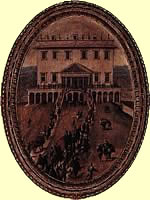 It is not easy to reconstruct with precision the history of the area in pre-Roman and Roman times. Some scholars hypothesise the presence of Roman settlements (such as a camp and a villa belonging to the Cai family), while others, drawing on the account of Livy, believe the area was uninhabited. Indeed, the Roman historian, narrating how Hannibal crossed these lands on his way from Mantua to Arezzo, describes them as marshy and therefore almost uninhabitable. Whatever the case, various sources testify that the hilly areas immediately surrounding present-day Poggio a Caiano were inhabited from the early Middle Ages. From the 10th century, the Poggio area was the property of the Cadalindi counts of Fucecchio and of the Olivetan monks of Pistoia; those lands later passed to the Pistoia family of the Cancellieri, who built a stronghold on the site then called Ambra. For a long time it was believed that this stronghold stood exactly where the Villa stands today, but recent studies suggest instead that a noble house — perhaps a remnant of the original fort — stood on the main road directly opposite the Medici residence, where civilian dwellings now stand. It seems that Lorenzo stayed in this house during his visits to the building site of the Villa. Moreover, from the 14th to the 18th century Poggio a Caiano was known as the river port of Prato: the last stretch of the Ombrone from the Ponte all'Asse (just before the town) was indeed a busy trade route which, via the Arno, linked the Prato and Pistoia basins with the ports of Pisa and Livorno.
2. From the Medici to the Savoy
In 1420 Palla Strozzi began buying land and buildings from the Cancellieri family, and it is in  this period that we find, for the first time in some documents, the name Poggio a Caiano mentioned alongside those of Bonistallo and Caiano. In 1488 another illustrious Florentine family began to take an interest in the area: Giovanni Rucellai purchased "the estate, inn and cottages of Poggio a Caiano". But the history of Poggio was to remain bound to another, far more celebrated family: that of the Medici. As early as 1431 Cosimo de' Medici had bought six farms in the area. His grandson Lorenzo the Magnificent, besides purchasing all the surrounding estates and beginning the construction of the Villa, undertook a broad programme of canalisation and regulation of the waters of the Ombrone and of rationalising the agricultural activities on the farms north of the river. A splendid testimony to Lorenzo's work in this regard is the farmstead of Poggio a Caiano-Tavola (a true example of an "ideal farm"), whose construction is thought to have begun in the spring of 1477. As a result of the works under way at the Villa and in its surroundings, numerous craftsmen — decorators, carpenters, masons and others — settled in the Poggio area. This community formed the first nucleus of the town, which thus came into being not as a farming village but as an offshoot of the Villa's building site, endowed from the start with an urban character. The favourable position, halfway between Florence and Pistoia, and the presence of the Villa (which, even after the extinction of the Medici dynasty, remained a summer court residence first of the Habsburg-Lorraine and later of the Savoy) contributed to the prosperity of the small town, which became one of the leading centres of the straw-craft industry (plaits, hats, and so on).
3. From the Second World War to the present day
The Second World War affected Poggio too, though not irreparably. On 8 August 1944 the town suffered heavy shelling, which caused the greatest destruction and a number of casualties. During that period, between late July 1944 and 10 September of the same year, around a thousand residents of Poggio took refuge in the Villa, a place able to offer safe protection from the bombing. In their disorderly retreat, however, the German troops did not forget to blow up the bridges over the Ombrone: the Ponte all'Asse, the Ponte del Mulino and the Ponte di Ferro. The latter was a fine example of early 19th-century civil engineering, one of the first examples of a suspension bridge with metal cables. Of this bridge, which linked the garden of the Villa to the Poggio a Caiano-Tavola farmstead, only the two great stone portals remain today. After the war the town underwent rapid economic transformation: the straw industry was replaced by that of yarns and knitwear. This development culminated in the town's separation from Carmignano, of which Poggio a Caiano had been a hamlet, and in the establishment of the Municipality (14 July 1962) — one of the smallest in Tuscany, with an area of just 5.97 km², but also one of the most densely populated and active. This separation should be understood within the economic process that affected the two municipalities in different ways. Carmignano, set within an essentially agricultural economic fabric, felt the imbalances stemming from the general crisis that struck Italian agriculture, while Poggio a Caiano — also thanks to its favourable location between Prato, Pistoia and Florence — accentuated its economic development in a craft and industrial direction, gradually becoming part of the economic area of Prato, characterised by wool textile activities. The reason for the separation was, in any case, the lack of essential structures and services, a shortfall already felt after the First World War.