 Italiano
SANTA CRISTINA IN PILLI
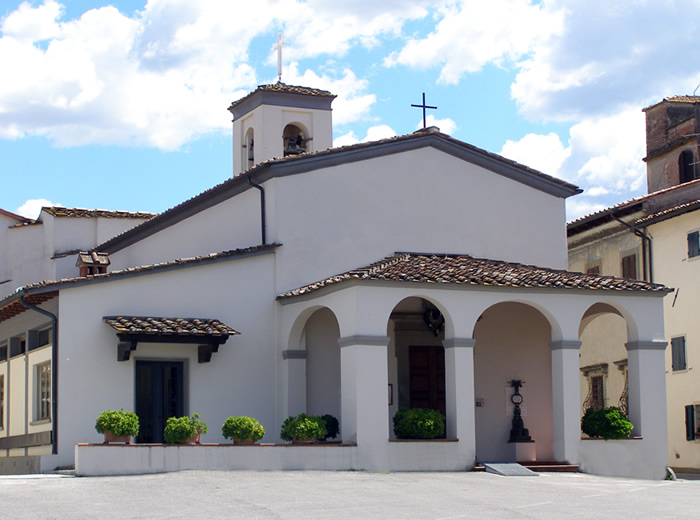 The hamlet of Santa Cristina in Pilli can be reached from the road leading to Carmignano. The name seems to derive from the place-name pinus and its derivatives pilli and pillo, fairly widespread in Tuscany. It may be assumed that this is the oldest inhabited nucleus of Poggio a Caiano. Indeed, the church of Santa Cristina in Pilli is mentioned for the first time in a notarial deed of December 1026. The present-day building nonetheless owes its form to alterations made during the 17th and 18th centuries. The church, compact and self-contained, is preceded by a portico, in whose floor two trapdoors open onto an old ossuary beneath the building. On the outer right-hand side is a marble bas-relief probably of Roman origin, which is thought to have been placed there, together with a stone inscription, in 1308. On the same wall, near the bell tower, is a plaque of pietra serena stone bearing the inscription "A.D. 1718", probably referring to a renovation of the bell tower itself. Inside, on the left, is the niche of the baptismal font, frescoed by the Sienese painter Quinto Martini, and a 1652 painting by Annibale Niccolò depicting the martyrdom of Cristina; on the right, a 15th-century fresco depicting a Madonna and Child, and a 16th-century polychrome wooden triptych painted with scenes of the Nativity. The pulpit and altars are probably 18th-century additions. The whole is well integrated within an articulated building complex of medieval origin that dominates a landscape still rich in charm.
BONISTALLO AND CERRETO
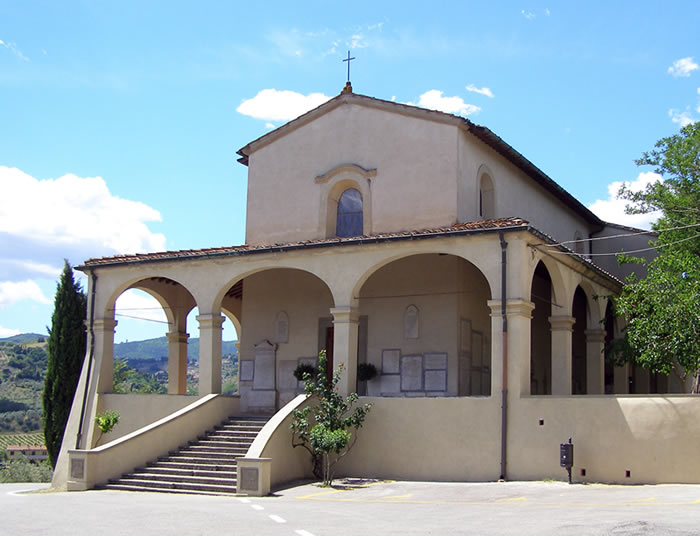 Along the road to Bonistallo, on the right, is the San Francesco retirement home for the elderly, once Villa Magra, already recorded in an 18th-century map as Villa Maghera, and later the property of the Marchesa Luisa Giaconi, who donated it to the Institute of the Minim Sisters. After passing one of the entrances to the Barco Reale on the left, one reaches the church of Bonistallo, the most panoramic point of the Poggio, as its Latin name attests: Bonum Stallum ("good" here referring also to the strategic position of this northern spur of the Montalbano, which dominates the entire plain between Florence and Pistoia). From here, besides having a complete view of the town, one can admire the whole plain as far as Florence and the surrounding hills. Here once stood the church of S. Maria a Bonistallo, the ancient parish church of Poggio, now converted into dwellings. It is a building dating from the late 16th century (consecrated in 1600), of late-Renaissance architecture already tending towards the Baroque; but a chapel "Sanctae Mariae de Bonistallo" is already mentioned as early as the 13th century. When the new Parish of Bonistallo (dedicated to San Francesco) was established in 1922, since it was impossible to restore the old church of S. Maria, the adjoining 18th-century oratory of the Compagnia delle Stimmate was used instead, surrounded by a bright and well-balanced portico. Not far from Bonistallo lies one of the places richest in historical memories in the Poggio area, the villa known as Cerreto, today a simple country villa, but once a genuine stronghold, as the two surviving circular towers and its strategic position, overlooking the road between Florence and Pistoia, attest. It has been suggested, though without firm proof, that the fortress called Torrebecchi, captured in 1325 by Castruccio Castracani in his attempt to conquer Carmignano, stood on this site. Legend has it that the villas of Cerreto and Poggio a Caiano were linked by a secret underground passage, which would have facilitated clandestine meetings between the two celebrated lovers, Grand Duke Francesco and the Venetian noblewoman Bianca Cappello, who spent the summer months at the villa of Cerreto. Of its ancient splendour, however, the present-day Cerreto retains nothing.
THE BARCO REALE
The Barco Reale park extends over about 14 hectares on the hill of Bonistallo, on the left of the SS. 66 coming from Florence. It is only a small part of the original Medici hunting reserve, which extended across a wide area of the Montalbano, and of which isolated traces can still be seen in the surrounding area, especially stretches of the boundary wall and of the entrances (the Barco had been divided in the 18th century into ten areas or "tenths", to allow more rational management). The original reserve, officially established in 1626 (although Lorenzo had already begun buying the land that formed part of it), included farms, estates and even the Medici Villa La Ferdinanda at Artimino. Besides being a hunting reserve, it constituted an immense, meticulously tended woodland estate (the establishment of the "tenths" was linked to a system of rotation in the felling of oaks). The whole Barco was enclosed by a wall closely guarded by "birri" (guards) resident on the estate; this was a measure to protect the reserve, but also a display of luxury and power on the part of the Medici. The Barco (or rather, what remains of it) is a large, shaded wood, made up mainly of holm oaks, downy oaks and other oak species. Nonetheless, it also contains specimens of numerous other tree species, including exotic ones, such as cedars and thorny acacias. It is criss-crossed by numerous shaded paths, some of which are suitable for vehicles. Inside are still to be found the buildings of the stables and the gatehouse, as well as structures used for other purposes, often in ruins.