 Italiano
The Medici Villa of Poggio a Caiano

From Lorenzo the Magnificent to the "Bella Rosina"
The Medici Villa of Poggio a Caiano was built for Lorenzo de' Medici and his heirs to a design by Giuliano da Sangallo between approximately 1485 and 1520, with a likely pause between 1495 and 1515 due to the Medici's exile from Florence. It always remained the Medici's summer residence and, besides hosting numerous notable guests, was the setting for important events in their dynastic history, such as the celebrations for the weddings of Alessandro de' Medici and Margaret of Austria (1536), Cosimo I and Eleonora of Toledo (1539), and Francesco I and Bianca Cappello, already his lover at the time (1579).
The Villa of Poggio was an obligatory stop for all new grand-ducal brides, who before entering the city would receive here the homage of the Florentine nobility: this was the case for Joanna of Austria, first wife of Francesco I, and for Christina of Lorraine, wife of Ferdinando I. In October 1587, Francesco I and Bianca Cappello themselves died at the Villa of Poggio, one a day after the other, of malarial fever, although oral tradition long held that both had been poisoned. The Villa was the favourite residence of Cosimo III's son, Prince Ferdinando, a great patron of the arts, who turned it into a highly active cultural centre.
On the death of Gian Gastone (1737), the last Medici descendant, the Villa passed to the new Tuscan grand dukes, the Habsburg-Lorraine, who continued to use it as a summer residence and as a stopover on their journeys towards Prato or Pistoia. Under Napoleonic rule the Villa underwent internal and external alterations (chiefly by Pasquale Poccianti), commissioned first by regent Maria Luisa of Etruria and later by Elisa Baciocchi Bonaparte, Napoleon's sister and, from 1809, Grand Duchess of Tuscany. The Villa became one of her favourite residences, and it is said that here she carried on a rumoured love affair with the celebrated violinist Niccolò Paganini, who gave numerous concerts in the Villa's theatre.

With the founding of the Kingdom of Italy and the arrival of the House of Savoy, Vittorio Emanuele II, a great lover of horses and hunting, had the Villa refurbished: new stables were built, some ground-floor rooms were redecorated, and the grand Leo X hall on the first floor was turned into a billiard room. With Vittorio came to Poggio the "bella Rosina", Rosa Vercellana, a woman of humble Turin origins who became the king's lover and later his morganatic wife: two fine bedrooms on the first floor, open to visitors, bear witness to this further love story. In 1919 the Administration of the Royal House donated the Villa to the Italian State.
The Villa
The Medici Villa of Poggio a Caiano is a splendid example of Renaissance architecture, blending the lessons of the classical world (Vitruvius in particular) with features typical of Tuscan rural noble architecture. Alberti's influence is evident, from the choice of the site on which the Villa stands to the symmetry and harmony of its proportions. The introduction of a basis villae (the arched platform on which the building rests) recalls classical models such as the temple of Jupiter Anxur at Terracina. Giuliano da Sangallo skilfully blended these elements, laying the foundations for a new architecture in which the lessons of the classical world were revitalised by innovative features.
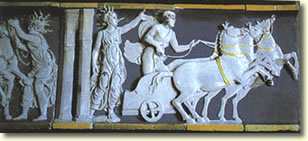
The exterior of the Villa has kept Sangallo's original Renaissance design fairly intact, with the exception of the two twin staircases leading up to the terrace, designed in 1807 by Pasquale Poccianti and built by Giuseppe Cacialli to replace the original straight staircases set perpendicular to the Villa's body. At the top of the stairs stands a loggia crowned by a pediment and a finely relief-decorated barrel vault. On the right-hand wall of the loggia a fresco depicts the sacrifice of Laocoön, by Filippino Lippi; on the architrave is a glazed terracotta frieze (attributed to Sansovino and Bertoldo di Giovanni) depicting mythologically inspired allegories linked to Lorenzo and his circle — the frieze on view today is a copy: the original, restored in 1986, is displayed in a room inside the Villa.
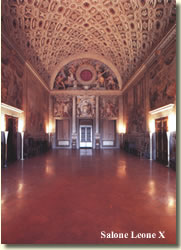
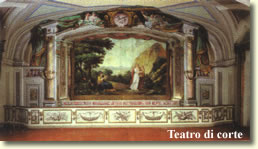
On the ground floor visitors can see the so-called apartment of Bianca Cappello, the entrance hall and the billiard room (both remodelled in Savoy style), and the 18th-century court theatre. On the first floor is the Villa's most remarkable space: the Leo X hall, probably completed around 1513. The painted decoration of the walls (1519–1582) is the work of Andrea del Sarto, Pontormo, Franciabigio and Alessandro Allori, depicting episodes of Roman history that allude to the glories of members of the Medici family. The lunettes portray mythological subjects: on the right, the Garden of the Hesperides by Allori; on the left, the allegory of Vertumnus and Pomona, a splendid masterpiece by Pontormo restored in 1993. The first floor is completed by the entrance hall with early-19th-century monochrome paintings by Giuseppe Catani, the dining room with the fresco by Antonio Domenico Gabbiani (1698), and the bedrooms of Vittorio Emanuele II and the "bella Rosina".
Visitor information
Admission to the Villa, the Still Life Museum and the Park is free of charge.
- Guided tours accompanied by the Villa's staff: at 8.30, 9.30, 10.30, 11.30, 12.30, 14.30 and 15.30.
- Visits are accompanied but not guided: anyone wishing for a guided tour should arrange one independently.
Also worth seeing: the park and garden, the monumental apartments and the Still Life Museum.